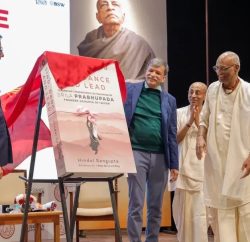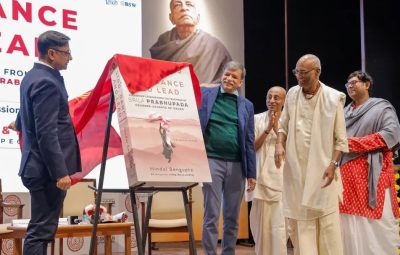



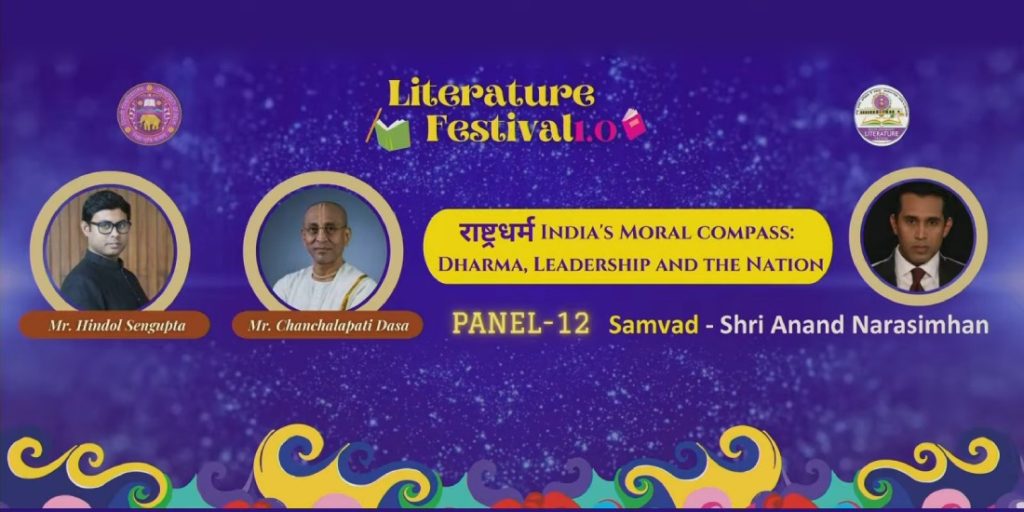
The panel at the DU Literature Festival shared insights on these concepts based on the book ‘Sing, Dance and Lead’.
Highlighting the theme ‘Nation First: Unity in Diversity’, the recently concluded Literature Festival, organised by Delhi University, brought together diverse cultures, traditions, arts and languages, creating a cultural confluence in the national capital.
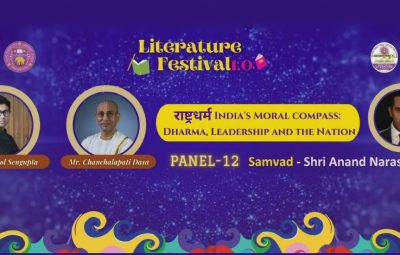
As part of this first-ever literature festival in the history of the university, a panel discussion among Shri Anand Narasimhan, Senior Anchor at CNN-News 18, Shri Chanchalapathi Dasa, Co Founder and Vice Chairman of The Akshaya Patra Foundation and Senior Vice President of ISKCON Bangalore and Prof.Hindol Sengupta, renowned author and historian, shed light on the fundamental principles and beliefs that are shaping our nation and leading us towards progress.
The venue was filled with students, professionals, intellectuals, and leaders from all parts of India, eagerly awaiting the gems of wisdom from the distinguished panellists. The conversation revolved around the topic – ‘India’s moral compass: Dharma, Leadership and the Nation’ in connection with the book Sing, Dance and Lead, authored by Prof.Hindol Sengupta, based on the leadership lessons of Srila Prabhupada, the Founder-Acharya of ISKCON, who created a spiritual and cultural revolution in the world.
The word ‘Dharma’ is mostly understood only as a Sanskrit term for religion. Is it really just religion or is there something more profound? Read on to know how Chanchalapathi Dasa elucidated it through Srila Prabhupada’s teachings.
Dharma can refer to one’s duty, the inseparable quality of something or the laws. Quoting the Bhagavatam verse dharmam tu sakshat bhagavat pranītam, he said Dharma is also the order given by God. And it is interesting to note that there is a convergence between these perspectives. If one does his duty according to the orders of God, he will be able to realise his intrinsic, inseparable nature and when his intrinsic nature blossoms, he will be able to understand and appreciate the true meaning of religion. When this happens collectively, as a community, the foundation of the nation will become stronger.
Impressed with this explanation of the commonly used but mostly misunderstood word ‘dharma’, Anand Narasimhan moved on to Hindol to understand his idea of a ‘nation’. Emphasising Chanchalapathi Dasa’s point and citing the references of a few historical figures, Hindol said that cultural heritage and spiritual foundation are the civilisational essence of our nation.
An interesting question for which most of us are seeking an answer, followed. Who am I? How should I introduce myself? Should it be based on religion, nationality or something else? Quoting the Bhagavad Gita shloka, “mamaivāṁśo jīva-loke jīva-bhūtaḥ sanātanaḥ”, Chanchalapathi Dasa beautifully explained that there is a higher reality than just a bodily identity. He said, “We are part and parcel of a divine spirit. We have a responsibility to offer loving service to that divine being. That is the spiritual reality and one’s true identity.”
With an understanding of dharma and nation, Anand Narasimhan shifted the attention to the book ‘Sing, Dance and Lead’ to explore Srila Prabhupada’s leadership style and how it will help build a moral compass.
Appreciating Srila Prabhupada’s invaluable contributions to humanity, Hindol said, “At the age of 70, when most people think of retirement in India, Srila Prabhupada sailed on a cargo ship to the United States of America. During the journey, he suffered two heart attacks. He had no money, no contacts, no possessions but his books and an unflinching faith in Lord Krishna. Yet, in a span of 11 years, he built a global movement.” He introduced Indian spiritual culture and traditions and made the Westerners sing and dance joyfully to the holy names of Lord Krishna – Hare Krishna, Hare Krishna, Krishna Krishna, Hare Hare, Hare Rama, Hare Rama, Rama Rama, Hare Hare.
People in general tend to think that chanting mantras is just ritualistic. Is it just a ritual, or is there a science behind it? How does it impact one’s life? Hindol clarifies that there is a deep connection between science and spirituality. He says that there is a powerful frequency or vibration in every word of the mantra that elevates our consciousness and links us to the Supreme.
Building on this, Chanchalapathi Dasa further explained, “There is no difference between Krishna and His holy name. So, when we chant Krishna’s name, we are in touch with Lord Krishna.” The analogy of fire and warmth helped the audience catch the point. He said, “Just like one feels warm when he comes in touch with fire, when we come in touch with Krishna, we get purified.”
The entire conversation drove home a very important point – Bharat’s civilisational ethos needs to be cherished. We should first treasure our own knowledge and our own culture. According to Prof. Hindol, in the modern era, we Indians accept only knowledge from the West, even if it originated in our own country. Citing the example of the concept of ‘servant leadership’, he elaborated, “When I was in business school, we were taught servant leadership by Green Leaf. (But) When I studied the Gaudiya Vaishnavite tradition, I discovered that centuries before Green Leaf, this idea of “Prabhu” existed. Why is God called Prabhu? I am at service to you. I am at service to God, and God lives in everything, and I am at service to man as well. This has been in our Bharatiya culture for centuries. But today in management schools, only the Green Leaf Servant Leadership is taught.”
Following a detailed discussion of various philosophical, cultural, managerial, historical, and scientific concepts, the panel left the audience with the understanding that a leader should work with the right consciousness, grounded in dharma. When we have dharmik leaders to guide the citizens on the right path, the nation will flourish. Thus, dharma, leadership and nation are interconnected, forming the moral compass of our glorious Bharat.
Sing, Dance and Lead is a must-read for all students, professionals, managers, aspiring leaders and book enthusiasts to learn and imbibe the qualities of an ideal leader from Srila Prabhupada’s life example. The book is available on e-commerce platforms like Amazon, Flipkart and Crossword.