


The Eleventh Cowherd Boy of Vrindavan
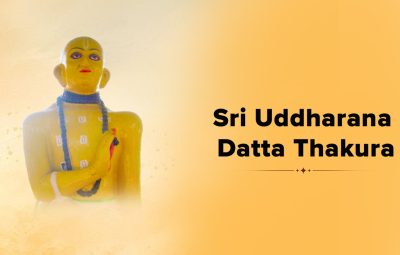
Srila Krishna Dasa Kaviraja Goswami writes in Sri Chaitanya-charitamrita (Adi 11.41) that Uddharana Datta Thakura was the eleventh among the twelve cowherd boys and an exalted devotee of Lord Nityananda Prabhu. He worshiped the lotus feet of Lord Nityananda in all respects. According to Gaura-gaṇoddeśa-dīpikā (verse 129), he was formerly the cowherd boy of Vrindavana named Subāhu.
His father’s name was Srikara Datta, his mother’s name was Bhadravati, and his son’s name was Srinivasa Datta.
Origins and Community Background
Uddharana Datta Thakura, previously known as Sri Uddharana Datta, was a resident of Saptagrama, situated on the bank of the Sarasvati River near the Trishabigha railway station in the district of Hugli. During his time, Saptagrama was a thriving metropolitan area, encompassing many localities including Vasudeva-pura, Banshabediya, Krishnapura, Nityananda-pura, Shivapura, Shankhanagara, and Saptagrama proper.
He belonged to the suvarna-vanik community—bankers and gold merchants (suvarṇa means “gold,” and vaṇik means “merchant”). This community was actually a Vaishnava community with deep devotional roots. The influential members of this mercantile community later developed much of Calcutta under British rule, with most belonging to the prominent Mullik and Sil families. More than half of Calcutta belonged to this community.
A Historical Injustice and Divine Redemption
The suvarna-vanik community faced social ostracism due to a historical misunderstanding with Ballal Sena. He was taking excessive loans from the great banker Gauri Sena and spending money extravagantly. When Gauri Sena stopped supplying funds, Ballal Sena retaliated by instigating a social conspiracy to declare the suvarna-vaniks as outcastes, separating them from the higher castes of brahmanas, kshatriyas, and vaishyas.
However, by the infinite grace of Srila Nityananda Prabhu, the entire suvarna-vanik community was purified and elevated. The Chaitanya-bhagavata confirms:
“yateka vaṇik-kula Uddharana haite pavitra ha-ila dvidhā nāhika ihāte“
There is no doubt that all members of the suvarna-vanik society were purified by Sri Nityananda Prabhu.
An Extremely Elevated and Liberal Vaishnava
The Chaitanya-bhagavata (Antya-khanda, Chapter Five) describes Uddharana Datta as an extremely elevated and liberal Vaishnava who was born with the inherent right to worship Nityananda Prabhu. This special relationship was demonstrated when Nityananda Prabhu, after staying for some time in Kharadaha, came to Saptagrama and personally stayed in the house of Uddharana Datta.
Life as a Householder
Srila Uddharana Datta Thakura remained a householder throughout his life, demonstrating that one can attain the highest levels of devotion while fulfilling worldly responsibilities. He served as the manager of the estate of a prominent zamindar in Naihati, about one and a half miles north of Katwa. The relics of this royal family are still visible near the Dainhata station. Since Uddharana Datta Thakura was the manager of the estate, it was also known as Uddharana-pura.
The Sacred Temple of Saptagrama
Uddharana Datta Thakura installed Sri Nitai-Gaura Deities, which were later brought to the zamindar’s residence known as Vanaoyaribada. In Saptagrama, there still stands a temple housing a remarkable six-armed Deity of Sri Chaitanya Mahaprabhu that was personally worshiped by Srila Uddharana Datta Thakura.
On the right side of Sri Chaitanya Mahaprabhu stands a Deity of Sri Nityananda Prabhu, and on the left side is Gadadhara Prabhu. The temple also houses Radha-Govinda murtis and a salagrama-sila. Below the throne is a picture of Sri Uddharana Datta Thakura himself. In front of the temple is a large hall, and before the hall grows a beautiful Madhavi-lata plant. The temple is situated in a very shady, cool, and pleasant location.
Temple History and Preservation
Srila Bhaktisiddhanta Sarasvati Thakura writes in his Anubhashya: “In the Bengali year 1283 (A.D. 1876), a babaji named Nitai Dasa arranged for a donation of twelve bighas of land (approximately four acres) for the temple. Though the management deteriorated for a period, it was revitalized in 1306 (A.D. 1899) through the cooperation of the distinguished Balarama Mullik of Hugli, who was a subjudge, along with many wealthy members of the suvarna-vanik community.
Around fifty years before, a family descendant named Jagamohana Datta established a wooden murti of Uddharana Datta Thakura in the temple. Though this wooden statue is no longer there, it was reportedly taken by Sri Madana-mohana Datta and is now worshiped alongside a salagrama-sila by Srinatha Datta. Currently, a picture of Uddharana Datta Thakura is worshiped in the temple.”
A Personal Connection
Srila Prabhupada shares a touching personal connection to this temple and community. He writes that in his childhood, he visited this temple with his parents, as all members of the suvarna-vanik community took enthusiastic interest in this sacred place. When he returned from America in 1967, the executive committee members invited him to visit, and he had the opportunity to bring some American students to this historic temple.