


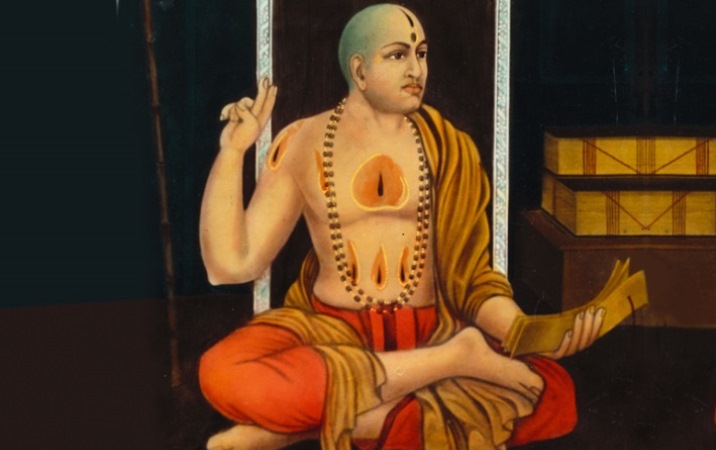
Sri Madhvacharya (1238-1317 A.D), also known as Vasudeva, Ananda Tirtha and Purnaprajna, is one of India’s greatest saint-philosophers. He was born of Tulu speaking parents at Udupi, Karnataka. The young Vasudeva, (Madhva’s boyhood name) expressed a desire to become an ascetic when he was eight years old.
His Position in the Disciplic Succession
Srila Madhvacarya is revered as the original acarya of the Madhva–Gaudiya sampradaya, also known as the Brahma sampradaya. This disciplic succession originates from Lord Brahma, who instructed Narada Muni, who instructed Vyasadeva, who then instructed Madhvacarya. Sri Chaitanya Mahaprabhu accepted this disciplic chain, establishing Madhvacarya as the foundational pillar of Gaudiya Vaishnava theology.
Birth and Family Background
Srila Madhvacarya appeared at Pajaka-ksetra in Udupi, South Kanarada district near Mangalore, in a Sivalli brahmana family as the son of Madhyageha Bhatta. According to historical records, he was born in 1040 Sakabda (A.D. 1119), though some traditions place his appearance in 1160 Sakabda (A.D. 1239). He was known as Vasudeva in his childhood.
Miraculous Childhood Pastimes
Even as a child, Madhvacarya displayed extraordinary divine qualities. He transformed tamarind seeds into coins to repay his father’s debts, destroyed a serpent demon named Maniman with the toe of his foot at the age of five, and possessed remarkable bodily strength and agility. He was invested with the sacred thread at an early age and exhibited exceptional intellectual brilliance.
Acceptance of Sannyasa
Despite family opposition, Madhvacarya accepted sannyasa at the age of twelve from Acyuta Preksa and received the name Purnaprajna Tirtha. He then traveled extensively across India, engaging in scholarly debates and preaching Vaishnava philosophy.
Meeting Vyasadeva at Badarikasrama
Accompanied by Satya Tirtha, Madhvacarya visited Badarikasrama, where he met Vyasadeva and presented his commentary on the Bhagavad-gita. Receiving divine approval, he was firmly established as a supreme authority in Vaishnava philosophy.
Recovery and Installation of the Udupi Krishna Deity
While meditating beside the ocean, Madhvacarya recovered a hidden Deity of Lord Krishna concealed within gopi-candana. He personally carried the Deity to Udupi and installed Him there, establishing eight monasteries governed by his direct disciples. The worship system he instituted continues at Udupi to this day.
Extensive Preaching and Heroic Travels
Madhvacarya undertook extensive preaching tours across India, assisting kings in public welfare projects, crossing dangerous regions fearlessly, refusing royal wealth and defeating bandits and wild animals through his extraordinary strength and courage.
The philosophy he preached was previously known as ‘tattvavada’. Now it is known as ‘dwaita’. He boldly told a Muslim king: “By whatever name you may call, God is One.” He maintained that one’s religion is not decided by birth but by his nature and personality.
Shankaracharya’s advaita-vedanta produced a profound dissatisfaction in the mind of the young Madhva, which often brought him into conflict with his teachers. In fact Madhva’s objection to advaita-vedanta became the most compelling force in this life and he spent much of his adult life arguing against this view of the world.
After studying in Udupi, Madhva traveled to Tamil Nadu where he continued to meet and debate with advaita scholars. Madhva soon returned to Udupi, but after a short time he left to visit Veda Vyasa at Badari in the northern Himalayas. Many months passed and when he finally appeared he was resplendent and joyful. He had received the blessings of Vyasa. Upon his return to Udupi, he immediately began to write his famous Brahma-sutra commentary.
During his lifetime, Madhvacharya wrote many important commentaries on the Upanishads, Bhagavad-gita, Brahma-sutra, Mahabharata and the Bhagavata-purana. The final years of Madhva were spent in teaching and worship. In the end he instructed his followers not to sit still, but to go forth and preach.
Defeating Mayavada Philosophers
He successfully defeated leading Mayavada philosophers, including Pundarika Puri, safeguarding the Vaishnava siddhanta. His disciple Trivikramacarya and later Narayanacarya preserved his teachings through authoritative writings such as Sri Madhva-vijaya.
Establishment of Monastic Centers and Lineages
Madhvacarya established Udupi as the principal center of his sampradaya and organized eight principal monasteries governed by his sannyasa disciples. He also established extensive disciplic successions that continue to guide Vaishnava worship and philosophy.
Departure and Legacy
Srila Madhvacarya departed from this world at the age of eighty while writing a commentary on the Aitareya Upanisad. His life of devotion, scholarship and divine strength laid the philosophical foundation of the Gaudiya Vaishnava tradition and continues to guide devotees worldwide.