


Early Life and Spiritual Identity
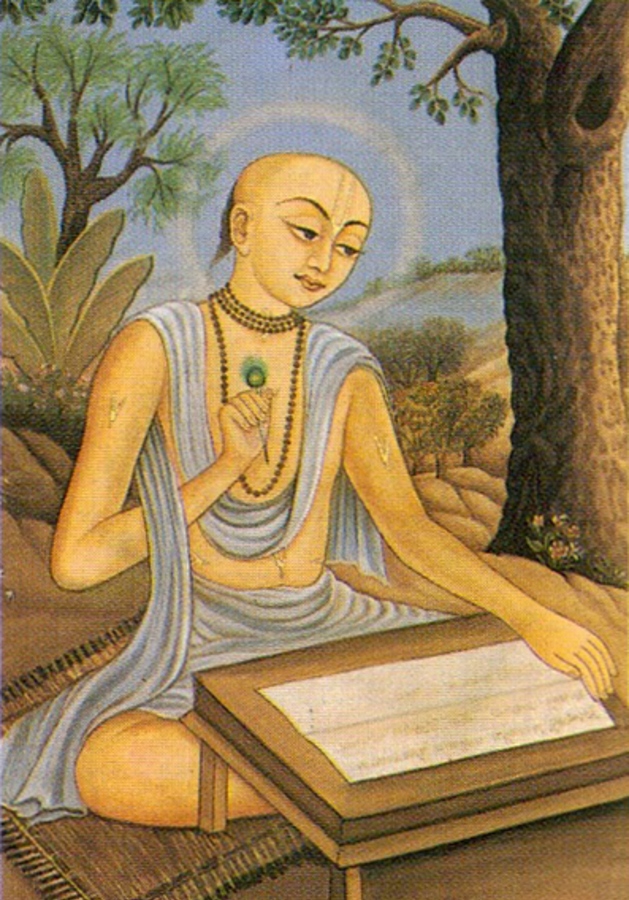
In the Gaura-gaṇoddeśa-dīpikā, verse 195, it is said that Srila Jiva Goswami was formerly Vilasa-manjari gopi. From his very childhood Jiva Goswami was greatly fond of Srimad-Bhagavatam.
Education and Spiritual Journey
He later came to Navadvipa to study Sanskrit, and, following in the footsteps of Sri Nityananada Prabhu, he circumambulated the entire Navadvipa-dhama. After visiting Navadvipa-dhama he went to Benares to study Sanskrit under Madhusudana Vacaspati, and after finishing his studies in Benares he went to Vrindavana and took shelter of his uncles, Sri Rupa and Sanatana. This is described in the Bhakti-ratnakara.
Literary Contributions
Sri Jiva Goswami, in order to please the Lord, later composed a grammar in Sanskrit, in which all the rules of grammar were explained with examples that used the holy names of the Lord. This grammar is still current. It is known as Hari-namamrta-vyakarana and is prescribed in the syllabus of schools in Bengal.
Sri Jiva Goswami composed and edited at least twenty-five books. They are all very celebrated, and they are listed as follows:
(1) Hari-namamrita-vyakarana,
(2) Sutra-malika,
(3) Dhatu-sangraha,
(4) Krishnarca-dipika,
(5) Gopala-virudavali,
(6) Rasamrita-shesa,
(7) Sri Madhava-mahotsava,
(8) Sri Sankalpa-kalpavriksha,
(9) Bhavartha-sucaka-campu,
(10) Gopala-tapani-tika,
(11) a commentary on the Brahma-samhita,
(12) a commentary on the Bhakti-rasamrita-sindhu,
(13) a commentary on the Ujjvala-nilamani,
(14) a commentary on the Yogasara-stava,
(15) a commentary on the Gayatri-mantra, as described in the Agni Purana,
(16) a description of the Lord’s lotus feet derived from the Padma Purana,
(17) a description of the lotus feet of Srimati Radharani,
(18) Gopala-campu (in two parts) and
(19-25) seven sandarbhas: the Krama-sandarbha, Tattva-sandarbha, Bhagavat-sandarbha, Paramatma-sandarbha, Krishna-sandarbha, Bhakti- sandarbha and Priti-sandarbha.
His disciple Krishnadasa Adhikari listed all the books of the Goswamis in his diary.
Leadership and Service
After the disappearance of Sri Rupa Goswami and Sanatana Goswami in Vrindavana, Sri Jiva Goswami became the Acharya of all the Vaishnavas in Bengal, Orissa and the rest of the world, and it is he who used to guide them in their devotional service. In Vrindavana he established the Radha-Damodara temple.
Relationships with Contemporary Devotees
When Jiva Goswami was still present, Sri Krishnadasa Kaviraja Goswami compiled his famous Sri Chaitanya-charitamrita. Later, Sri Jiva Goswami inspired Srinivasa Acharya, Narottama dasa Thakura and Duhkhi Krishnadasa to preach Krishna consciousness in Bengal. Jiva Goswami was informed that all the manuscripts that had been collected from Vrindavana and sent to Bengal for preaching purposes were plundered near Vishnupura, in Bengal, but later he received the information that the books had been recovered. Sri Jiva Goswami awarded the designation Kaviraja to Ramacandra Sena, a disciple of Srinivasa Acharya’s, and to Ramacandra’s younger brother Govinda. While Jiva Goswami was alive, Srimati Jahnavi-devi, the pleasure potency of Sri Nityananada Prabhu, went to Vrindavana with a few devotees.
Charitable Nature
Jiva Goswami was very kind to the Gaudiya Vaishnavas, the Vaishnavas from Bengal. Whoever went to Vrindavana he provided with a residence and prasada.
Responding to False Accusations
The sahajiya group makes three allegations against Sri Jiva Goswami. Vishwa Guru Srila Prabhupada explains these accusations in detail in his commentary on Sri Chaitanya-charitamrita.
The First Accusation: The Scholar Incident
The first accusation concerns a materialist who was very proud of his reputation as a great Sanskrit scholar and approached Sri Rupa and Sanatana to argue with them about the revealed scriptures. Sri Rupa Goswami and Sanatana Goswami, not wanting to waste their time, gave him a written statement that he had defeated them in a debate on the revealed scriptures. Taking this paper, the scholar approached Jiva Goswami for a similar certificate of defeat, but Jiva Goswami did not agree to give him one. On the contrary, he argued with him regarding the scriptures and defeated him. Certainly it was right for Jiva Goswami to stop such a dishonest scholar from advertising that he had defeated Sri Rupa Goswami and Sanatana Goswami, but due to their illiteracy the sahajiya class refer to this incident to accuse Sri Jiva Goswami of deviating from the principle of humility.
The Principle of Humility and Defense of Superiors
Sahajiyas do not know, however, that humility and meekness are appropriate when one’s own honor is insulted but not when Lord Vishnu or the Acharyas are blasphemed. In such cases one should not be humble and meek but must act. One should follow the example given by Sri Chaitanya Mahaprabhu. Lord Chaitanya says in His Shikshashtaka (3):
tṛṇād api sunīcena
taror ivasahiṣṇunā
amāninā mānadena
kīrtanīyaḥ sadā hariḥ
“One can chant the holy name of the Lord in a humble state of mind, thinking himself lower than the straw in the street. One should be more tolerant than a tree, devoid of all sense of false prestige, and should be ready to offer all respect to others. In such a state of mind one can chant the holy name of the Lord constantly.”
Nevertheless, when the Lord was informed that Sri Nityananda Prabhu was injured by Jagai and Madhai, He immediately went to the spot, angry like fire, wanting to kill them. Thus Lord Chaitanya has explained His verse by the example of His own behaviour. One should tolerate insults against oneself, but when there is blasphemy committed against superiors such as other Vaishnavas, one should be neither humble nor meek; one must take proper steps to counteract such blasphemy. This is the duty of a servant of a guru and Vaishnavas. Anyone who understands the principle of eternal servitude to the guru and Vaishnavas will appreciate the action of Sri Jiva Goswami in connection with the so-called scholar’s victory over his gurus, Sri Rupa and Sri Sanatana Goswami.
The Second Accusation: The Chaitanya-charitamrita Manuscript
Another story fabricated to defame Sri Jiva Goswami states that after compiling Sri Chaitanya-charitamrita, Sri Krishnadasa Kaviraja Goswami showed the manuscript to Jiva Goswami, who thought that it would hamper his reputation as a big scholar and therefore threw it into a well. Sri Krishnadasa Kaviraja Goswami was greatly shocked, and he died immediately. Fortunately a copy of the manuscript of Sri Chaitanya-charitamrita had been kept by a person named Mukunda, and therefore later it was possible to publish the book. This story is another ignominious example of blasphemy against a guru and Vaishnava. Such a story should never be accepted as authoritative.
The Third Accusation: The Parakiya-rasa Controversy
According to another accusation, Sri Jiva Goswami did not approve of the principles of the parakiya-rasa of Vraja-dhama and therefore supported svakiya-rasa, showing that Radha and Krishna are eternally married. Actually, when Jiva Goswami was alive, some of his followers disliked the parakiya-rasa of the gopis. Therefore Sri Jiva Goswami, for their spiritual benefit, supported svakiya-rasa, for he could understand that sahajiyas would otherwise exploit the parakiya-rasa, as they are actually doing at the present.
Unfortunately, in Vrindavana and Navadvipa it has become fashionable among sahajiyas, in their debauchery, to find an unmarried sexual partner to live with to execute so-called devotional service in parakiya-rasa. Foreseeing this, Sri Jiva Goswami supported svakiya-rasa, and later all the Vaishnava Acharyas also approved of it. Sri Jiva Goswami was never opposed to the transcendental parakiya-rasa, nor has any other Vaishnava disapproved of it. Sri Jiva Goswami strictly followed his predecessor gurus and Vaishnavas, Sri Rupa Goswami and Sanatana Goswami, and Sri Krishnadasa Kaviraja Goswami accepted him as one of his instructor gurus.